
Giving ordinary people a voice in society
Who We Are       About Our Films       For  Schools       Partnerships       News       Events & Screenings       Contact Us      

 Films + Groundswell


Food Patriots


What Can Doc Makers Learn from Kony 2012?


By Jennifer Amdur Spitz
Share this Article
Post on Facebook
Post on Twitter
Email Story

Although we have plenty of criticism of  Kony 2012 video,  it offers important lessons about HOW documentary can contribute to social change.  As storytellers, we know the power of the specific to illuminate a larger social problem, and the power of one voice to make a difference. Groundswell works collaboratively and uses film as a vehicle for people to tell their own stories across cultures.  We’ve had a lot of success in moving policymakers and people to take action — see www.navajoboy.com. But with Kony 2012, the voice of the ‘other’ is silent. They never speak.  Everything about Kony 2012 is from the outside in. Looking beyond the controversy,  I want to learn from the success of the campaign  and try to understand what makes it work.

First,  they made the issue super simple (deceptively simple?).  In this instance, it seems irresponsible, but in general, simpler messages work best. In our Return of Navajo Boy campaign, when we spoke of Elsie’s house made of Uranium rock, it brought tons of media and a federal response.  The Uranium house opened the door to a much larger and deeper examination of the issues of uranium contamination on the Navajo Reservation.  A deeper look into the LRA is probably not the intent of Kony 2012, and neither the film or the campaign are attracting those who might be so inclined. Get the bad guy is a pretty simple concept, and it appeals to millions.

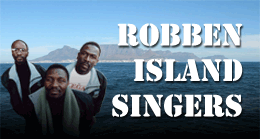
Another observation is that the filmmakers broke the fourth wall. The filmmakers are visible, they tell their story from their own perspective, and their objective is clear from the outset.  This seems important.  We are experimenting with this transparency in our newest film, Food Patriots (www.foodpatriots.com), and I have to admit, being in the film feels mighty uncomfortable. We didn’t put ourselves much in www.RobbinIslandSingers.com, and people were confused about Groundswell’s role. They seldom understood that the Singing group and education project were our doing, and could understand even less our motivation for doing it.  The manner that Russell expresses his point of view is repulsive to some, but the folks he’s trying to reach identify with his western perspective and his motive, so in that regard, he’s right on his target.

Another observation is that we see ourselves in this film and we like our reflection. “We” are the privileged, the tech-savvy, and the social media using audience. We have the power to be a savior, to wear the white hat, and to get instant recognition among our friends.  The film is not about Kony, the LRA , the generations of child soldiers, ,orphans, or even Jacob. Its about us;  the power we can wield with a click of a finger, and the power we can influence if we all click together.

Kony 2012 emboldens my belief in Groundswell’s mission, and in the possibilities for documentary to truly influence social change.  There are so many incredible filmmakers out there making media that can make a difference — Kartemquin Films,  Siskel/Jacobs Productions, and even veterans like Michael Moore. Kony 2012 gives us all lessons we can use to re-activate the films we have made, and to borrow from elements that spawned success here to make our future work even more effective at moving audiences to take action.

     Permalink to this item     Leave a comment


Robben Island Singers Rough Cut Goes to South Africa


  • ;:
By Jeff Spitz
Share this Article
Post on Facebook
Post on Twitter
Email Story

The cinematic journey of three singing ex-political prisoners traveled full circle when Muntu Nxumalo (musical director) presented our 90 minute rough cut of the film in Kwa Mashu, the largest township in Kwa Zulu Natal – home township of the singers. Muntu arranged with Edmund Mhlongo to show the film to youth involved in performing arts and media at Ekhaya Multi-Arts Center.

Muntu reports that South African high school students know very little about apartheid and the struggle for liberation and that they were in fact astonished to see the ex-prisoners engaging with American high school students and news reporters in Chicago. Muntu says the emotional impact of this story is very powerful because parents such as himself have found it difficult to talk about their prison years. Local audiences told Muntu they want more scenes in the film about apartheid, Robben Island prison and the musical response of today’s South African teens.

Consider joining our Producer’s Circle by donating $1,000. Your contribution will help cover the cost of editing the rough cut. Click here to donate.

     Permalink to this item     Leave a comment


Navajo Boy Makes Waves – New Book and French Premiere


  • ;:
By Alan Slavik
Share this Article
Post on Facebook
Post on Twitter
Email Story

This Fall The Return of Navajo Boy screened with Navajo guest speakers at sponsored public events in the Navajo Nation, Salt Lake City, Chicago; Portland, and France!

In the Navajo Nation, Indian Health Service collaborates with Groundswell to engage audiences in remote communities impacted by uranium mining. Participants from the film, Elsie Begay, her son Lorenzo, and daughter-in-law Mary Begay travel across the reservation to lead discussions.

In the Midwest, the University of Chicago Law School hosted a screening and panel discussion with filmmaker Jeff Spitz, Navajo activist Mary Begay, and author Judy Pasternak. Pasternak’s new book: Yellow Dirt: An American Story of a Poisoned Land and a People Betrayed features the Navajo family in our film. Pasternak appears in our film’s 2008 Epilogue which is now available on DVD.

Bennie Klain, Co-producer, traveled to France for the Premier of The Return of Navajo Boy at the Amiens International Film Festival. (See photos on Groundswell’s Flickr page.) Groundswell Board member, Alan Slavik, a Paris-based marketing consultant, attended the Amiens premier and is planning future screenings in Paris.

     Permalink to this item     Leave a comment


Documentary Filmmaker Ordered to Hand Over Oil Footage


  • ;:
By Alan Slavik
Share this Article
Post on Facebook
Post on Twitter
Email Story

US Courts last month ruled in favor of Chevron’s request to view 600 hours of outtakes from the award-winning film Crude: The Real Price of Oil. The film chronicles the struggle of Ecuadorians against Chevron’s oil contamination of their land.

In this highly unusual case, Judge Lewis Kaplan, of the district court in Manhattan, awarded Chevron access to footage that could ultimately add to the company’s defense in a $27 billion case that spans more than seventeen years.

Judge Kaplan ruled that transparency and justice would be served by allowing the company access to the outtakes including interviews with environmental activists including Sting.

The decision brings into question the freedom of documentary filmmaking and journalist’s privilege. Filmmaker Michael Moore has said that the decision could have a “chilling effect.”

In a recent interview, Crude director Joseph Berlinger commented on the ruling. “It’s just a complete disregard for any belief in the first amendment. I am a journalist. I am covered by a journalist’s privilege,” said Berlinger. “We are shocked by the judge’s decision, at the broadness of the request.”

Berlinger plans to appeal the verdict, and is seeking donations to cover his legal fees.

     Permalink to this item     Leave a comment


“Papers the Movie” Gives Voice to Undocumented Youth


  • ;:
By Arlen Parsa
Share this Article
Post on Facebook
Post on Twitter
Email Story

A new documentary is shining a light on undocumented youth who were born outside the U.S. but raised in America– and the struggles they face.

“Papers the Movie” is the story of five undocumented high school students who risk deportation. 475 screenings of the film have taken place nationwide, according to the Papers The Movie website, which has a goal of reaching 1,000 screenings. One such screening was held on Capitol Hill as recently as May 18th.

According to the filmmakers, approximately 2 million undocumented children live in the United States. “65,000 undocumented students graduate every year from high school without ‘papers’ and find the door to the future slammed shut,” the producers say, noting that it is illegal for them to work or drive. “For most there is no path to citizenship.”

The producers of the film hope that Congress will approve the DREAM Act, which could provide that path to citizenship if youth attend an American college or join the military.

     Permalink to this item     Leave a comment


“Return of Navajo Boy” & “Robben Island Singers” at Amnesty International’s Film Festival


By Arlen Parsa
Share this Article
Post on Facebook
Post on Twitter
Email Story

Groundswell’s award-winning documentary The Return of Navajo Boy will screen at Amnesty International’s Human Rights Film Festival on Saturday, April 24th 2010 in Silver Spring Maryland.

Filmmaker Jeff Spitz, Groundswell’s co-founder, will also be on hand to also present a work in progress screening of his upcoming project, Robben Island Singers.

For more information, see the festival’s official website.

Update: Read a report from the Amnesty International Human Rights Festival.

     Permalink to this item     Leave a comment


Paris Film Festival Focuses on Human Rights and Education


  • photo:
By Alan Slavik
Share this Article
Post on Facebook
Post on Twitter
Email Story

For the past eight years, the Paris International Film Festival on Human Rights (FIFDH) has focused on raising awareness and film education for schools and students regarding the complexities of human rights breaches involving economic, social, cultural, civil, and political rights.

This year’s Prix Spécial du Jury was awarded to Buenos Días, Seguimos en Guerra (Hello, Our War Continues) by Anita Blumer (watch a trailer here). The film focuses on Guatemala and the war-like conditions that prevail in the wake of a civil war as the state remains undercut by organized crime. Guatemala has one of the highest murder rates on the American continent and violence claims more than ten lives a day. The film documents urban crime and the people who struggle against it.

The Human Rights Films Network (HRFN)

Since 2004, this film festival network has aimed to promote the protection of human rights on a global level. The network now brings together more than twenty festivals in the world, some of which are backed by major international human rights protection organizations such as Amnesty International and Human Rights Watch.

The network strives for better distribution of human rights films and intends to endorse the emergence of new film festivals on human rights, especially in developing countries. Every year, the HRFN attracts a combined audience of more than 200,000 viewers worldwide.

More information can be found at their website, www.festival-droitsdelhomme.org.

     Permalink to this item     Leave a comment


Winnie Mandela to Give Keynote Address at the Jubilee Film Fest


  • photo:
By Alan Slavik
Share this Article
Post on Facebook
Post on Twitter
Email Story

The Robben Island Singers movie trailer has been selected to kick off the Jubilee Film Festival in Selma, Alabama on March 6th.

The Festival Co-Directors, Erica Henry, (representing the Voting Rights Museum in Selma) will screen the trailer to introduce the theme of this year’s festival: struggle in the American South and South Africa.

Winnie Mandela will be the keynote speaker in this festival which culminates with a celebratory crossing of the Edmund Pettis Bridge, commemorating the 45th anniversary of the famous civil rights march.

Visit selmajubilee.com for more information about the festival, and robbenislandsingers.com for more information about Groundswell’s film and concert project featuring Robben Island Singers.

     Permalink to this item     Leave a comment


The Return of Navajo Boy Screening at The University of Illinois at Chicago (UIC)


By Arlen Parsa
Share this Article
Post on Facebook
Post on Twitter
Email Story

The University of Illinois at Chicago (UIC) will host a special screening of Groundswell Educational Film’s award winning documentary “The Return of Navajo Boy” November 9th from 3PM to 5PM. The event, featuring documentary filmmaker Jeff Spitz and other panelists, will be held at the Jane Addams Hull House Museum’s Residence Dining Hall at 800 S Halstead Street in Chicago.

The screening, hosted by UIC’s Institute for Research on Race and Public Policy, is part of a series of events celebrating Native American Heritage Month. UIC students can learn more about this scheduled event on the University calendar.

“The Return of Navajo Boy,” an official selection of the Sundance Film Festival and PBS, is now available on DVD with a recently updated epilogue (individual discounts also available).

     Permalink to this item     Leave a comment


The Return of Navajo Boy Screening at Miami U’s Native American Film Festival


By Arlen Parsa
Share this Article
Post on Facebook
Post on Twitter
Email Story

“The Return of Navajo Boy” was screened on November 5, 2009 as part of The University of Miami (Ohio)’s Native American Film Festival. For more information about this event, please visit the U of M’s website.

     Permalink to this item     Leave a comment


Connect    With Us Latest    Headlines


Email Us | Join Our Groundswell

Green Fest

Elsie Mae Begay’s Speaking Engagements with “The Return of Navajo Boy” film

Uranium Mines Dot Navajo Land, Neglected and Still Perilous

Film shows impact of uranium mining on Navajo land

What Can Doc Makers Learn from Kony 2012?


Copyright © 2012 Groundswell Educational Films. Login. Chicago Public Relations by Amdur Spitz & Associates.

Reverse phone lookup